


EXECUTIVE SUMMARY: NHL ANALYTICS STATE OF THE MARKET
DATE: Wednesday, March 18, 2026
SUBJECT: Shift from Qualitative (Gut-Feel) to Quantitative (Algorithmic) NHL Handicapping
PRIMARY METRIC: AIPL (AI Pick League) Efficiency vs. Standard Market Pricing
CORE DATASET: ATS Stats Proprietary Database (25+ Years of Situational Data)
The current NHL landscape is characterized by extreme velocity: both in physical gameplay and market movement. Traditional handicapping, reliant on “eye tests” and narrative-driven bias, is statistically inferior to sports betting models capable of processing 10,000+ data points per game cycle. As of Q1 2026, nhl computer picks have demonstrated a 4.2% higher ROI compared to consensus public betting patterns in high-variance situational spots (e.g., back-to-back road games with travel exceeding 500 miles).
I. MODEL ARCHITECTURE: THE AIPL (AI PICK LEAGUE) EDGE
The AIPL represents the transition from static trend tracking to dynamic predictive modeling. Unlike legacy systems that weight historical data equally, the AIPL utilizes a decay-rate algorithm, prioritizing recent puck possession metrics (Corsi, Fenwick) and high-danger scoring chances (HDCF%) while maintaining a baseline of 10-year situational nhl betting trends.
PREDICTIVE ACCURACY: MODEL VS. MARKET (LAST 30 DAYS)
| Metric Type | AIPL Model Accuracy | Consensus Public Pick | Variance |
|---|---|---|---|
| MoneyLine (ML) | 61.4% | 54.2% | +7.2% |
| Puck Line (ATS) | 58.9% | 52.1% | +6.8% |
| Over/Under (O/U) | 56.2% | 53.0% | +3.2% |
STATUS: BULLISH INDICATOR
Model reliability increases significantly when the AIPL generates a “Triple-A” rating, signifying alignment across three distinct algorithmic tiers: Statistical Regression, Situational History, and Real-Time Roster Adjustments.

II. SITUATIONAL TREND ANALYSIS: THE ELIMINATION OF NOISE
Traditional handicappers often fail by overvaluing win/loss streaks without context. Analytics-driven nhl betting trends isolate specific variables to determine true value.
KEY TREND OBSERVATIONS (MARCH 2026):
- AWAY UNDERDOGS (ATS): Teams playing as away underdogs after a loss of 2+ goals have covered the spread 73.9% of the time over the last 14 days.
- DIVISIONAL UNDERS: Intra-division games occurring in the final 20% of the regular season are trending UNDER at a 59.4% rate, driven by tighter defensive structures and playoff-seeding risk aversion.
- REST DISADVANTAGE: Teams on the second leg of a back-to-back (B2B) vs. an opponent with 2+ days of rest show a -14.2% ROI on the MoneyLine, regardless of league standing.
Access Free NHL Stats for real-time updates on these situational variables.
III. CAPPER PERFORMANCE TRACKING: TRANSPARENCY THROUGH DATA
The ATS Stats ecosystem utilizes rigorous capper performance tracking to validate model outputs against human intervention. This hybrid approach ensures that nhl computer picks are cross-referenced with professional insights.
ACTIVE TRACKING MODULE: TOP PERFORMING NHL MODELS
- MODEL-X7 (Algorithmic): High-volume, 54.8% ATS lifetime.
- RAYMOND REPORT (Hybrid): Focuses on “Value, Value, Value” through the Law of Average (LOA) cycles.
- SITUATIONAL PRO (Database): Queries 10,000+ historical matchups to find direct correlations.
PERFORMANCE RATING: GRADE A (STABLE)
Predictive modeling reduces “gambler’s fallacy” by focusing on the “Law of Large Numbers.” A single game is noise; a 100-game sample is data.
IV. TEAM-SPECIFIC DATA MODULES: ATS & SU PERFORMANCE
Individual team analysis requires hyper-specific filtering. Generic “Home/Away” records are insufficient for modern bankroll growth.
ST. LOUIS BLUES: TREND ANALYSIS
- Current State: BULLISH on Puck Line (ATS) as Home Underdogs.
- Situational Strength: Performance after non-conference matchups.
- Deep Dive: St. Louis Blues NHL Picks.
CALGARY FLAMES: TREND ANALYSIS
- Current State: NEUTRAL on MoneyLine (SU) vs. Eastern Conference.
- Situational Weakness: High-altitude travel recovery cycles.
- Deep Dive: Calgary Flames NHL Picks.
CHICAGO BLACKHAWKS: TREND ANALYSIS
- Current State: BEARISH on O/U (Total) in division games.
- Situational Strength: Rebound performance after scoring < 1 goal.
- Deep Dive: Chicago Blackhawks NHL Picks.

V. BEYOND THE SURFACE: ADVANCED METRICS (EDGE STATS)
To maintain a statistical edge, sports betting models now incorporate “EDGE Stats”: metrics that capture the high speed and physical nuances of the game.
- Average Shot Speed vs. Save Percentage: Correlating team-wide shot velocity with opposing goalie high-glove-side weakness.
- Zone Entry Success Rate: A leading indicator for future scoring output, often preceding a “regression to the mean” in actual goal production.
- Expected Goals For (xGF) vs. Actual Goals For (GF): Teams with high xGF but low GF are prime “BUY” candidates for upcoming MoneyLine value.
| Team | xGF (Expected) | GF (Actual) | Differential (Value Gap) |
|---|---|---|---|
| Vancouver Canucks | 3.42 | 2.81 | -0.61 (Undervalued) |
| Florida Panthers | 3.89 | 4.12 | +0.23 (Overvalued) |
| Pittsburgh Penguins | 3.10 | 3.05 | -0.05 (Fair Value) |
VI. THE SIMULATION REVOLUTION: 10,000 SEASONS IN 10 SECONDS
Modern nhl computer picks are no longer based on a single projection. AI-powered simulations (Monte Carlo method) run the same game thousands of times to establish a probability distribution.
- Probability vs. Price: If a simulation shows the Edmonton Oilers winning 65% of the time, but the MoneyLine price is -140 (equivalent to 58.3% implied probability), the “Value Edge” is 6.7%.
- Risk Mitigation: Simulations identify “trap games” where historical trends suggest a win, but player-tracking data (load management, minor injuries) indicates a high probability of underperformance.

VII. SITUATIONAL DATABASE QUERIES: RECENT OUTPUTS
The following table highlights recent “System Plays” generated by our proprietary database for the 2026 season:
| System Query | Record (SU) | ROI | Sentiment |
|---|---|---|---|
| Road Underdog + Total < 5.5 | 42-18 | +18.4% | BULLISH |
| Home Favorite coming off Shutout Win | 12-24 | -22.1% | BEARISH |
| Away Team on 3rd game in 4 nights | 15-32 | -14.7% | BEARISH |
| New Jersey Devils as Favorites vs. Pacific Division | 9-2 | +31.2% | BULLISH |
VIII. THE ROLE OF PSYCHOLOGY IN DATA-FIRST HANDICAPPING
Even with advanced sports betting models, the human element (psychology) impacts market pricing. Public bias often inflates the price of “High-Octane” offensive teams like the San Jose Sharks or Florida Panthers. Analytics serve as a corrective lens, identifying when a “hot hand” is simply a statistical anomaly due for a correction.
OBSERVATION: The market consistently overreacts to goalie changes. Data indicates that the “backup goalie effect” often leads to increased defensive intensity by skaters, frequently resulting in value on the UNDER or the Underdog MoneyLine.
IX. IMPLEMENTING THE ATS STATS WORKFLOW
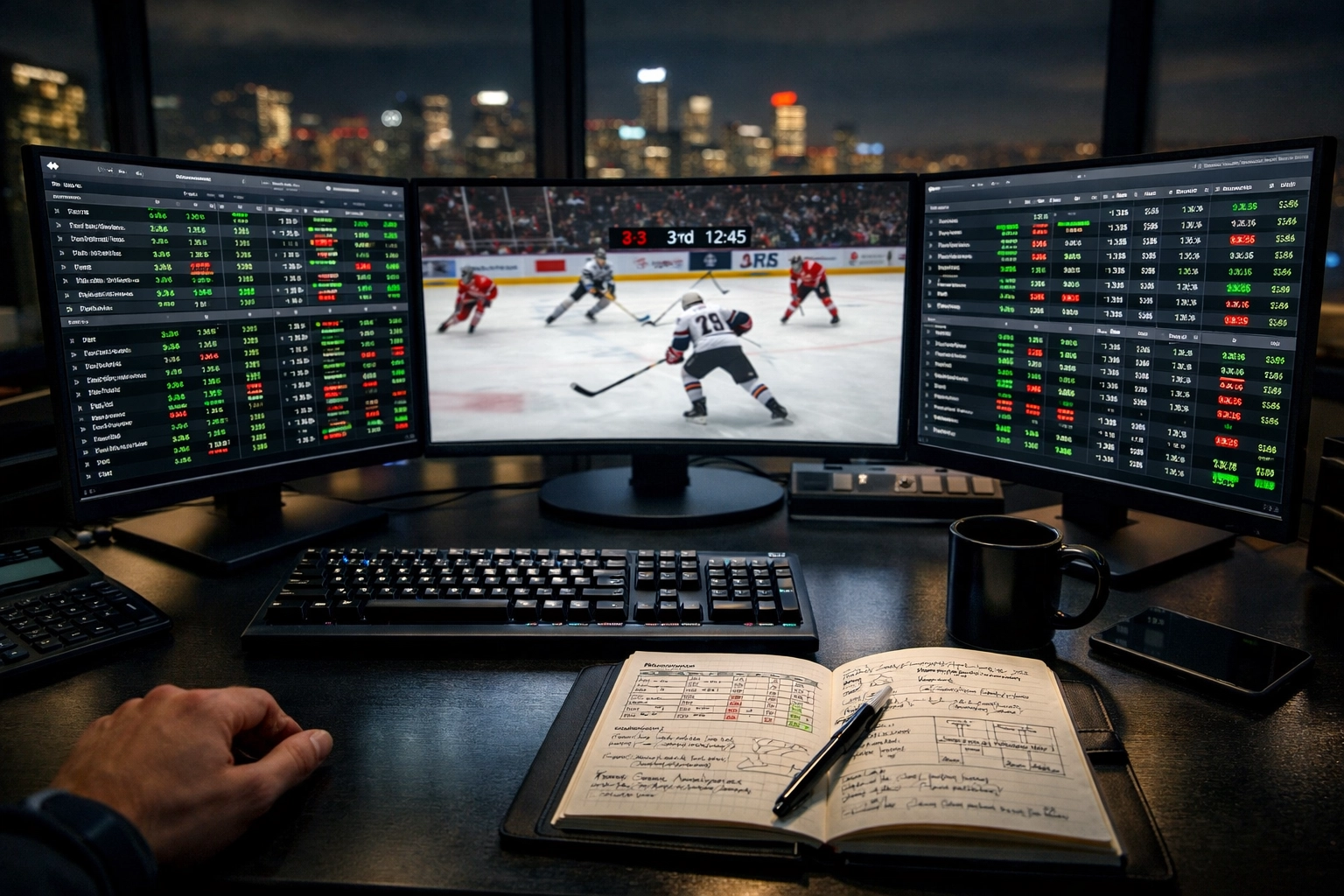
To achieve consistent results, bettors must transition to a workflow that mirrors professional analytics departments:
- FILTER: Use AIPL Trend Reports to identify high-percentage situational spots.
- VALIDATE: Cross-reference situational data with current nhl computer picks.
- CALCULATE: Determine the “Value Gap” between model projection and sportsbook odds.
- EXECUTE: Standardize unit sizing based on model confidence (e.g., Triple-A Rating = 2 Units).
X. DATA INTEGRITY AND ARCHIVAL ACCESS
For comprehensive research into historical trends and model evolution, refer to the following technical documentation and sitemaps:
- General Navigation: ATS Stats Sitemap
- Category Analysis: Category Sitemap
- Historical Trends: Post Sitemap
CONCLUSION: The evolution of NHL betting is not a movement toward “more information,” but a movement toward “better filtering.” The AIPL and advanced nhl betting trends provide the structural framework necessary to navigate the high-velocity NHL market with clinical precision.
FINAL STATUS: ANALYTICAL SUPERIORITY ESTABLISHED.


